

The smarter a company uses data, the greater the profit. This is known not only by international software companies like Google, Meta, and Microsoft, but also by companies in the manufacturing industry. Clever networking of data creates the greatest added value. Therefore, interface standards that ensure cross-manufacturer communication of machines and the smooth exchange of measurement results in the factory are increasingly coming into focus. How can we get the most out of the data? Answers to this central question will be provided at EMO Hannover 2025 from September 22 to 26. At the world's leading trade fair for production technology, visitors can familiarize themselves with the latest trends in industrial production under the motto 'Innovate Manufacturing.'
Every machine generates huge amounts of data. In the past, they were considered a byproduct; today, they are an indispensable raw material that can help make manufacturing more efficient. This way, manufacturing companies can secure a decisive competitive advantage even in times of skilled labor shortages and high international competitive pressure. Additionally, smart data usage can reduce emissions and increase the sustainability of production to meet rising regulatory challenges.
Global language of production

Data can only be optimally utilized if there is barrier-free communication between the machines. Such a 'universal language of production' in a connected factory is enabled by the open interface standard OPC UA (Open Platform Communications Unified Architecture). OPC UA, on which the universal interface umati (Universal Machine Technology Interface) is based, ensures the interoperability of machines and systems that can be interconnected and reshaped as needed via Plug & Work – platform-independent and manufacturer-agnostic.
'OPC UA enables interoperability between a wide variety of machines and systems, regardless of the manufacturer,' confirms Heiko Wenzel-Schinzer, Chief Digital Officer (CDO) of the measurement technology specialist Wenzel Group based in Wiesthal, Franconia.
'This creates the foundation for a fully connected production, where measurement results can flow directly into process control. The advantage: reduced sources of error, faster response times in case of deviations, and increased efficiency in manufacturing.'
Recognizing trends and patterns
Through smooth data exchange, statistical analyses become possible to recognize trends or patterns in the data and derive insights for optimizing manufacturing processes. A concrete application possibility for this is the monitoring of tool wear in production. Through continuous measurement and data analysis, deviations in product quality can be detected early. 'This data flows directly into statistical models that provide precise predictions about the optimal replacement time of a tool - this reduces downtime and material waste,' explains Wenzel-Schinzer, who, in addition to his position as CDO of Wenzel Group, also holds a professorship for business administration, business consulting, and process management in the Department of Business and Information Sciences at Merseburg University.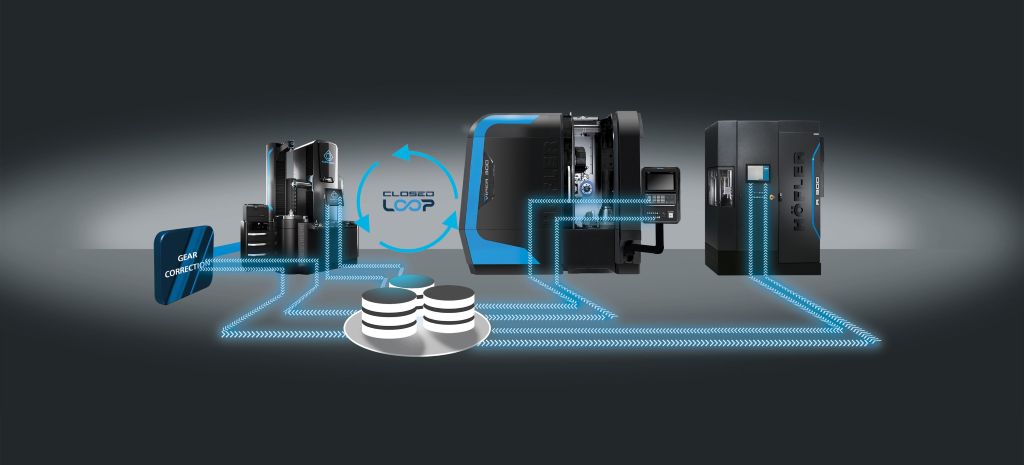
However, to achieve targeted results with machine data, several hurdles must be overcome. 'A central challenge is the harmonization of data formats and protocols to ensure cross-manufacturer interoperability,' says Wenzel-Schinzer. Additionally, there is the secure handling of sensitive data in a connected environment, especially regarding cybersecurity. Furthermore, the integration of standards like OPC UA requires close collaboration between various industry players. 'This is where associations come into play,' says the Chief Digital Officer of Wenzel Group, which showcases coordinate measuring machines and gear measuring devices at EMO.
Another concrete application example is the closed loop between measuring machines and systems of the gearing specialist Klingelnberg, located in Hückeswagen in the Bergisches Land. Alexander Troska, Head of Software Development at Klingelnberg, describes the process as follows: 'The grinding machine produces gears with the desired quality. Due to tool wear, parameters slowly drift away. Regular measurements are carried out on our precision measuring machines on freshly manufactured workpieces, trend developments are determined, and countermeasures are initiated.'
Low and high frequency

On the Klingelnberg gear grinding machines, a variety of data is collected: low-frequency condition data, high-frequency control data, and process settings. 'We combine this machine-near data with measurement and test results of the gears in the GearEngine, a Klingelnberg-owned platform,' adds Daniel Meuris, Head of Digitalization and Virtualization at Klingelnberg. This data integration can then provide extensive knowledge about cause-effect relationships in the analysis of quality problems.
To achieve optimal results, extensive knowledge of the entire manufacturing and measurement process is necessary, explains Jan Häger, Head of Software Development for Precision Measuring Centers at Klingelnberg.
'Every workpiece has its own requirements for quality, cycle, and setup time. Experience and knowledge of the different manufacturing processes help in data evaluation,' says Häger. But artificial intelligence, such as machine learning, is already being used.
Standardization ensures compatibility

Here, too, smooth data exchange between production machines and measurement technology is the focus. In the past, Klingelnberg predominantly used proprietary formats that have partially established themselves as industry standards. Today, Klingelnberg, which showcases face gear grinding machines, face gear rolling testing machines for identifying the causes of gearbox noise, and precision measuring centers with hybrid measurement technology at EMO, is consistently switching to standard interfaces like OPC UA umati. 'These help us and the customer keep the interfaces compatible in the long term,' says Häger.
Artificial intelligence or the digital twin are expected to bring significant advancements in this context. 'Artificial intelligence and digital twins will make manufacturing in digital factories significantly more efficient in the future,' believes Troska. By creating virtual replicas of real systems, processes can be optimized and potential problems detected early. 'AI-based systems enable precise quality control and autonomous production. The result is more efficient, flexible, and smarter factories that can quickly adapt to changing market conditions,' says Troska.
Advantage through OPC UA
Does cross-manufacturer data exchange and analysis in the factory provide a competitive advantage, especially in comparison to European with North American and Asian providers? Daniel Meuris, the digitalization expert from Klingelnberg, says that there is a strong focus on MQTT, an open network protocol for machine-to-machine communication, particularly in North America. 'OPC UA is more in demand in other parts of the world. With OPC UA, we can better meet the various requirements worldwide from Europe,' says Meuris.
Contact: