
Adaptability is a crucial advantage in a time characterized by high product customization, demand fluctuations, intense competition, and changing (trade) political regulations.
Agile production systems seem to pose challenges for SMEs, as medium-sized businesses often have to operate with limited resources while remaining competitive. However, flexibility is not a 'luxury' for large companies, but a strategic necessity – especially when margins are tight and production volumes are low. Logistics plays a key role in this.
The Fraunhofer IWU and IPA institutes have developed a methodology that supports companies in evaluating and gradually implementing the potentials of flexible production through a structured process – even without large investments. In many cases, existing resources (machines, systems, processes, employee qualifications) can be further utilized.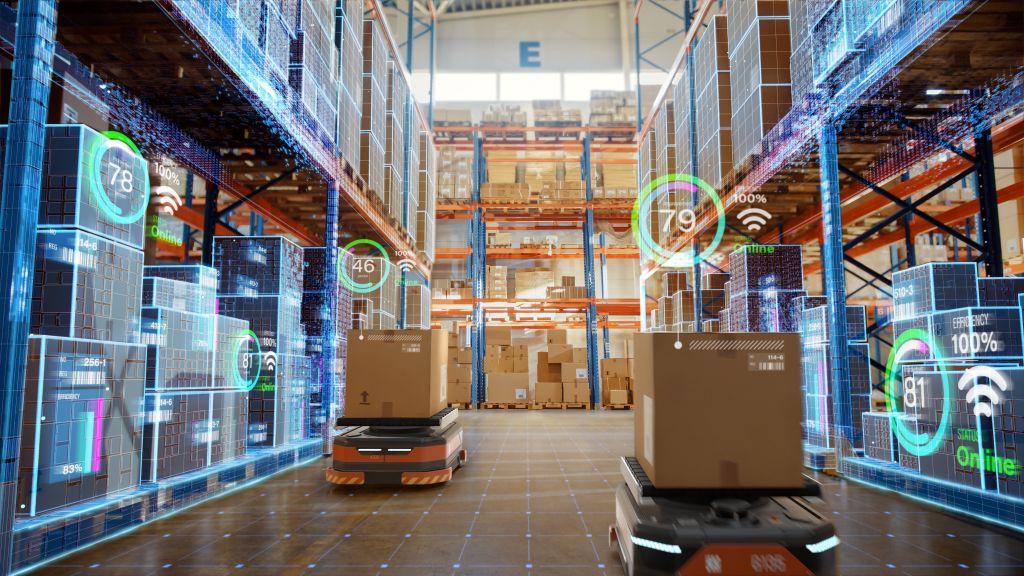
Modular and mobile components help to deploy the machinery for different products and to expand or reduce it cost-effectively as needed (scalability). In many industries, quickly implementable solutions have already been developed for typical starting situations. Solutions that can be scaled according to demand for different company sizes and adapted to various industries.
Example Repair Shop: Replacement of a line concept with a scalable production system, supplied via a high-bay warehouse.
Classic production lines with near-conveyor supply and fixed, short cycle times quickly reach their limits – especially when it comes to a production program that not only 'presses' many variants (different components) into one cycle but also enforces different manufacturing sequences. If particularly large components also need to be accommodated, the advantages of a line concept, such as high output of (largely) identical products with short manufacturing times, turn into their opposite: it is too rigid to allow for greater variance and takes up a lot of space for supply logistics – every required part must be brought from a more or less fixed intermediate storage location to a designated point in the line.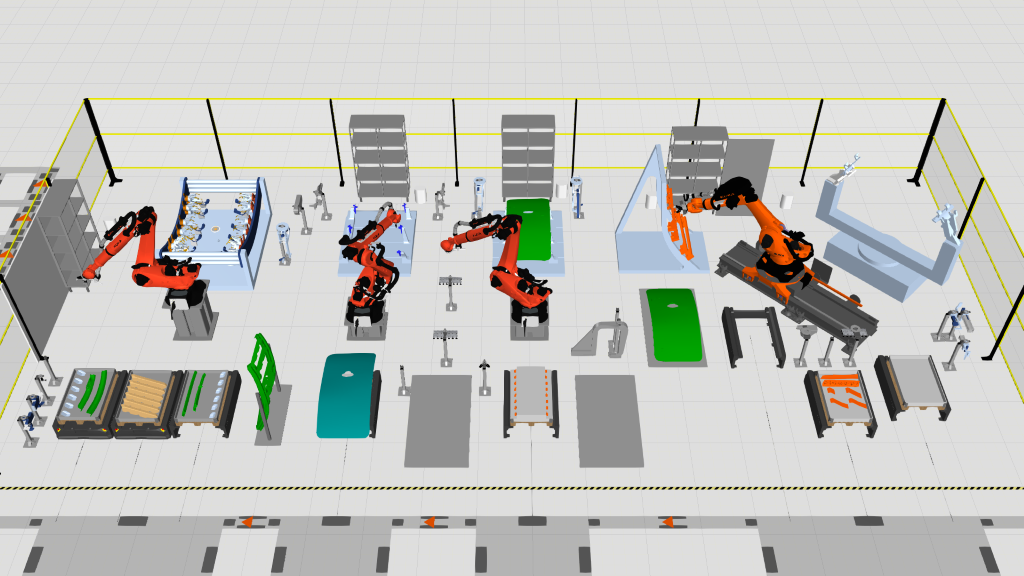
This finding applies particularly to repair shops that handle component sizes of up to two meters in length and width. If the repair portfolio includes products manufactured over several model generations, the demand for storage capacity for parts to be processed or replaced is particularly high. If only outdated conveying technology is available, it is time to consider sensible automation solutions.
The main focus for the project team at Fraunhofer IWU was therefore logistics with an automated multi-story high-bay warehouse. The goal was to make the material flow more flexible, directly connect the production stations to the warehouse, and efficiently handle different component types and quantities. Using a material flow simulation in Siemens Plant Simulation, various scenarios were modeled, and key figures such as throughput, lead time, and utilization of the storage retrieval systems (automated transport systems for storage/retrieval) were evaluated. The simulation showed that a logistics concept with an automated multi-story high-bay warehouse meets the required performance indicators and can respond flexibly and scalably to changing production requirements. Challenges such as variant-related, individual process sequences were taken into account in the model, and performance parameters of the high-bay warehouse such as throughput rate, lead times, utilization, and buffer stocks were optimized.
Example Aircraft Doors: Reduce manufacturing times by more than twenty times with a new material and manufacturing concept.
The production of doors for passenger aircraft is predominantly manual work. Many intermediate steps are required to avoid direct contact between different materials, which leads to corrosion. If instead of aluminum, titanium, and duroplastics, primarily thermoplastic carbon fiber reinforced materials (CFRP) are used, which can be automatedly welded together without separating layers, the process is significantly faster – the manufacturing time for the door structure decreases from 110 hours to just 4 hours. This was demonstrated by a research project from Fraunhofer IWU, Fraunhofer LBF, Trelleborg, and Airbus Helicopters.
A key to shorter assembly times also lies in the modular design for different aircraft door variants. The project team focused on components in various door models that can be standardized. This includes, for example, the cross member. The researchers designed a fully automated assembly line for the most common models and developed devices and clamping elements suitable for the joining technologies of resistance welding and ultrasonic welding.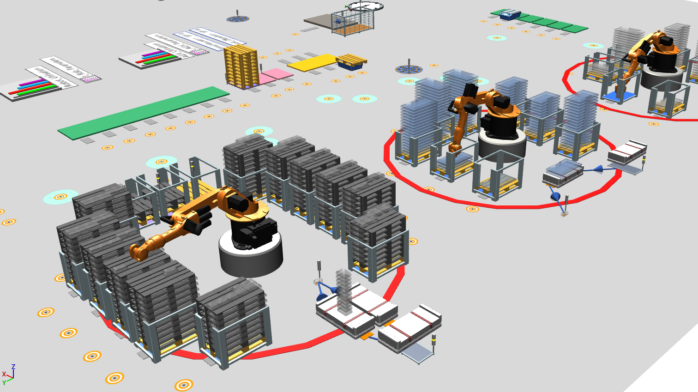
The IWU team simulated all technical and economic aspects of the new assembly line – which often condition each other. The most important technical evaluation criteria include the complexity of the product and production process, automation opportunities and risks from the perspective of flexibility and adaptability, or the overall availability of the system in a chain of various individual automations.
Result: Considering all technical, logistical, and economic criteria, the newly developed automation solution should be implemented.
Example AutoLog: efficient order picking at high quantities thanks to driverless transport systems that supply robots with components.
Efficient picking processes are essential for just-in-time production, especially with high product variety and large, heavy components. Classic automation is often inflexible, expensive, and difficult to scale in this area.
Dynamic picking, on the other hand, follows a 'goods-to-robot' principle and uses driverless transport systems (FTS) as well as a facility-close warehouse for high flexibility and product variety. Scaling occurs through simple expansion of the robot cells and FTS fleet, with forklift traffic completely decoupled. The software solution AutoLog, a joint development of Fraunhofer IWU and Volkswagen AG, enables Volkswagen Slovakia to configure and control such cells in self-service and optimizes processes with intelligent algorithms. AutoLog allows the initial design of robot cells, controls robots, safety technology, and FTS, minimizes waiting times, and integrates tools for error analysis. The virtual commissioning takes place via a software-in-the-loop simulation between AutoLog and a simulation model in Siemens Plant Simulation. This allows for early evaluation of new plant configurations even before they are put into operation.
Contact: